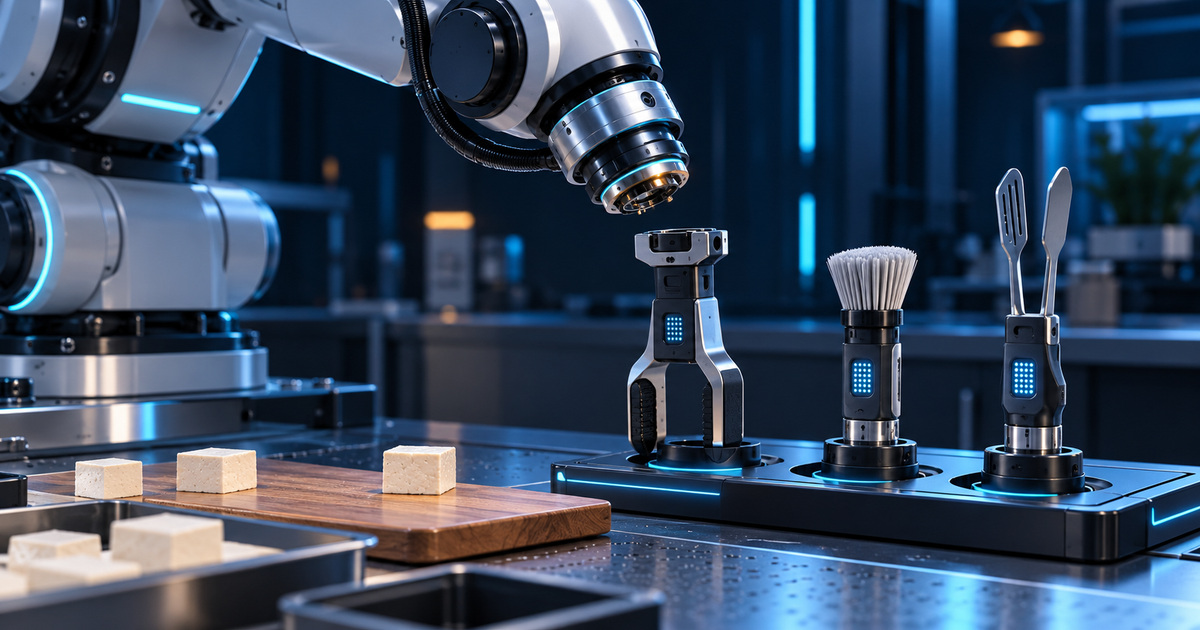
SwapBot is a University of Washington system with interchangeable tools and tactile sensors. Its October 29 preprint identifies predefined intermediate goals, sensor wear and low sensor resolution as limitations.
Those limitations set an important boundary for interpreting the demonstrations: they show a research system, not a finished robot that independently plans every household activity. The numbers below therefore need to be understood in the context of the specific experiment.
### What was actually compared
The project page describes training with 100 demonstrations per stage and evaluating individual skills over 20 trials each in a 20 × 20 centimetre workspace. Compared with RGB-only policies, adding touch raises success from 70 to 85% for brushing, 75 to 90% for cutting and 45 to 70% for tongs. These are author-reported numbers, not independently replicated by SIExpo.
The differences are 15, 15 and 25 percentage points respectively. They concern individual skills. They do not establish a success rate for an entire sequence, much less guarantee operation in an unfamiliar home. A video of a completed activity and a quantitative comparison answer different questions and should be interpreted separately.
### Why specialization is interesting
The engineering idea is understandable without an anthropomorphic hand. Brushing, cutting and transporting require different kinds of contact with an object. A suitable tool can simplify part of the mechanical problem while introducing another: reliably selecting, attaching and tracking that tool's state. This is our editorial interpretation of the trade-off, not proof of a universal reduction in cost or complexity.
Touch and images provide different kinds of information. In a hypothetical task involving a slippery object, a camera could help locate it while a contact signal could help assess the grip. A particular application would still need to measure whether this extra information justifies sensor maintenance and calibration. Having more input signals does not by itself establish reliability.
### From laboratory result to a useful system
In a subsequent evaluation, we would look for behavior when a tool is incorrectly seated, a swap is interrupted or an object moves during the action. How the robot detects the mistake and returns to a safe state would also matter. These are proposed evaluation criteria; we are not claiming that SwapBot has already solved them successfully.
The scale and diversity of the experiment also determine what can be concluded. A measurement in a limited workspace is useful for comparing configurations under similar conditions. Broader conclusions require other objects, different arrangements and longer runs, including unsuccessful attempts. Publishing such evidence would enable a more meaningful comparison than selecting only the best demonstrations.
SwapBot merits attention as a concrete attempt to connect tool mechanics, contact sensing and learned control. The reported results support further investigation of that approach. They do not establish that general robot operation in everyday environments is a solved problem.
Editorial check: 2026-11-01T19:30:20+02:00 (Europe/Sofia).