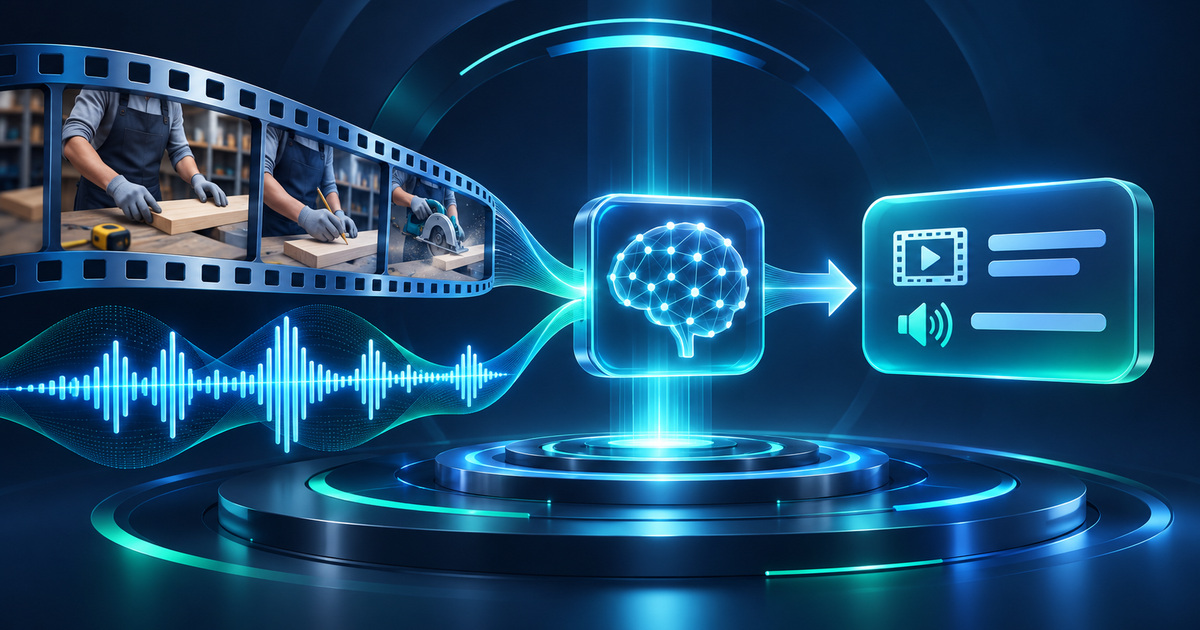
Tencent presents WeMM-Video in a preprint dated November 19. The family focuses on joint audio-visual understanding and Chinese-English operation. Inputs can include text, images, audio and video, while the output is text. It is an interpretation system, rather than a video generator.
Released variants include 2B, 4B, 9B and 35B-A3B, with modes for direct answers or more extensive reasoning. Those labels describe different configurations; they do not establish identical cost or reliability for every task. Reported results come from the authors and have not been independently reproduced by SIExpo.
One modality cannot replace the other
Our practical example is a clip in which someone performs an action while commenting on it. A description could be checked separately against the frames and soundtrack. If those cues conflict, a useful answer would preserve the disagreement rather than smooth it into a persuasive narrative. This is a proposed criterion, not a measured result for WeMM-Video.
A pilot could compare the same clips with and without audio. That lets a team examine whether the extra channel actually helps answer its questions. A general benchmark position need not become a promise about every local collection, language or recording type. Selecting representative examples is more useful than assuming that adding another input always improves an answer.
Execution has its own environment
The repository describes Python 3.12, NVIDIA CUDA 12.9 and FFmpeg as part of the example environment. Its code is under Apache 2.0; individual checkpoints and dependencies warrant separate review. Loading additional model code should be a deliberate action tied to a reviewed version, rather than automatic trust in every downloaded file.
We suggest retaining the weight version, input processing, questions and expected supporting evidence for an evaluation. When an answer identifies an action, a reviewer should be able to find the relevant evidence in a particular part of the recording. Missing and uncertain answers belong in the report alongside successes, rather than disappearing from the final presentation.
Defining the application boundary
The approach may be interesting for searching and describing audio-visual material, but selection depends on the actual task and rights over the data. We do not assume the system can identify a speaker without error or establish why an event happened. The family provides tools for investigating joint understanding; the reliability of an individual answer remains something the application needs to verify.