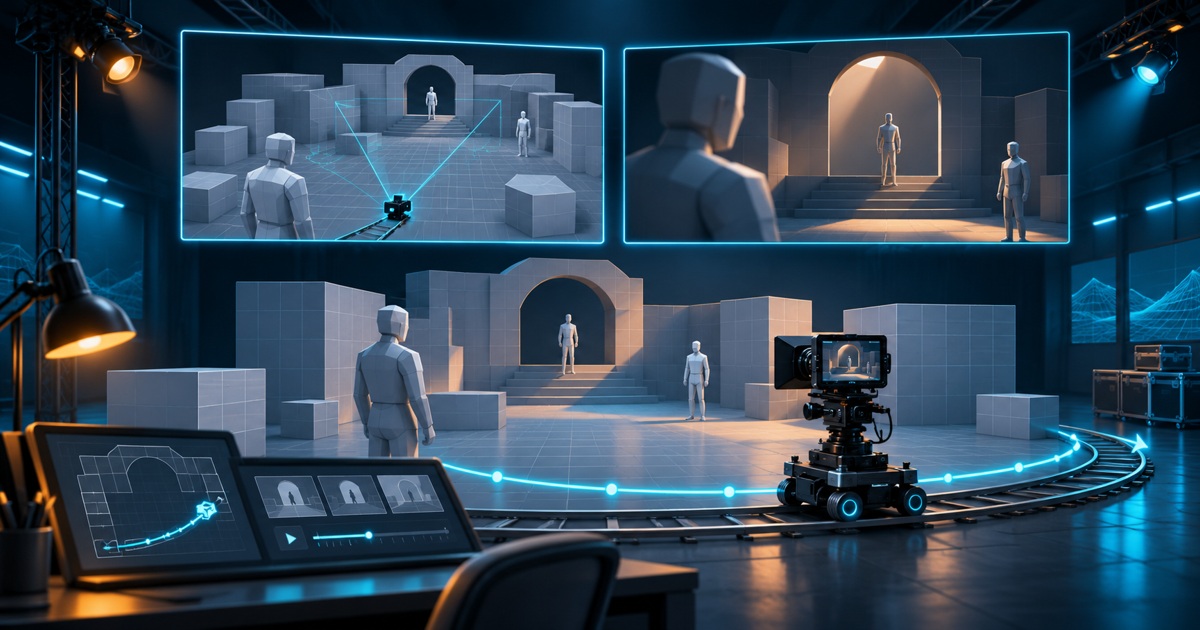
VibePrevisBench, introduced in a November 11 preprint, evaluates agents that turn a brief into an executable Blender scene evolving over time. The authors describe 242 tasks and analyze 11 coding agents. Such scenes can provide previsualization before a generator produces the final video appearance.
The benchmark combines two assessments. Scene Check executes the code and compares scene properties with hidden facts; Screen Check uses a vision-language judge to assess what is recognizable in the render. This dual assessment is the central news: an attractive image does not establish task completion.
Two distinct failure modes
Our example illustrates the distinction. A brief asks a person to pass behind an object and emerge on the right. Code might contain the correct trajectory while the camera looks elsewhere. Conversely, a convincing frame can conceal a path that violates the actual instruction.
This goes beyond cosmetic quality. When an intermediate scene controls a subsequent generation stage, improved textures do not necessarily repair staging. A team assessing only the final visual impression can miss a spatial or temporal constraint violation.
The authors’ analysis finds basic staging abilities alongside difficulties with demanding requests and self-correction. That is not a universal judgment about every current tool. Outcomes depend on the selected agents, their versions, tasks and evaluation procedure.
Verify the correction itself
SIExpo’s assessment distinguishes an agent inspecting a render from identifying and repairing the specific error. Acceptance criteria should name the object, time and camera view that must show the required event. After a correction, the same criteria should be checked again.
A visual judge can also be wrong. Important requirements may benefit from inspecting scene data and using a human-reviewed sample. These answer different questions and should not automatically be collapsed into one quality score.
For a creative workflow, the most useful test might be a small set of difficult briefs rather than a large gallery of attractive outputs. Include occlusion, timing, several shots and a deliberate correction request. Track whether the revision fixed the targeted error without breaking previously satisfied conditions. These are our proposed evaluation choices, not additional experiments conducted by the paper’s authors.
SIExpo has not run the benchmark or reproduced its ranking. This is uncovered research within the last week, with its actual date stated. Its practical lesson for developers and creative teams is concrete: accepting generated video should test the intended scene and events, rather than visual smoothness alone.
Editorial verification: 2026-11-17T07:54:00.882419+00:00.