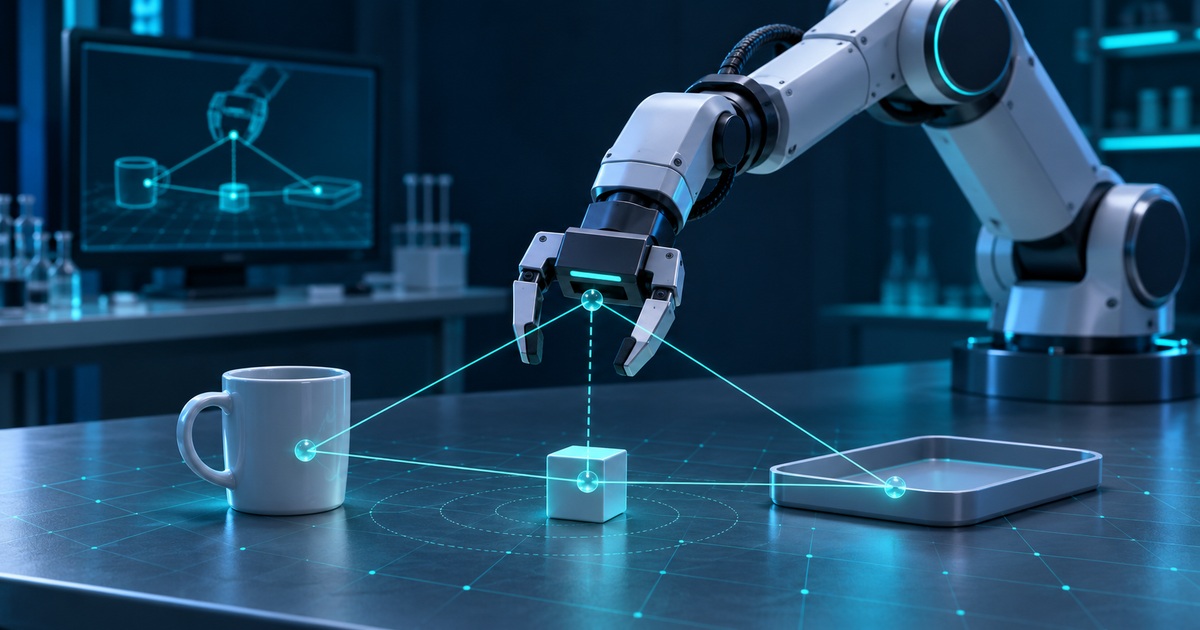
WeaveVLA is a research framework for models connecting vision, language and robotic action. Its first arXiv version was submitted on November 23; the current second version is dated November 24. The team adds explicit relative three-dimensional relations among objects, the gripper and nearby references, maintaining them across observations.
In one LIBERO-Plus comparison, the authors report an increase from 74.9% to 82.0%. That is 7.1 percentage points, not a 7.1% relative gain. The paper also includes three physical tasks, but those do not establish universal behavior in arbitrary real environments.
Beside, on and between are action requirements
A robot instruction often depends on relationships, not merely object recognition. A cup needs to sit beside a box, an item must remain inside a tray, and the gripper may need to approach from an unobstructed side. Naming the object correctly does not guarantee the right motion.
Explicit relational representation attempts to make this intermediate problem more visible to the model. It does not eliminate perception errors. If position is estimated incorrectly, a structure can consistently preserve the wrong relationship. This is a general limitation of the approach, not an independently observed WeaveVLA failure.
Simulation and physical evidence remain distinct
Simulation permits many repetitions and controlled changes. A physical robot introduces friction, compliance, noise and movement limits. Strong results in the first setting are useful progress, but are not equivalent to sustained operation in the second.
Our interpretation is that a follow-up evaluation should compare identical instructions while changing one factor at a time, such as lighting, object position or object identity. When several conditions change together, attributing a gain becomes difficult. Contacts and superficially successful but unstable placements should also remain visible in the record.
Memory must be correctable
Remembered spatial context helps only if the system can update it after a change. A person moving an object or a blocked camera can make earlier information stale. Evaluation therefore needs to consider recovery after contradictory observations as well as retention of relationships.
The publication supplies a concrete method and results to examine. It is a preprint, not certification of a robot product, and SIExpo has not reproduced the experiments. Its promise is a better connection between spatial representation and action. Its scope remains bounded by the tasks, platforms and conditions the authors actually evaluated.
Cover: AI editorial illustration, not a photograph of the research setup.