The November 16 WeVisForensics preprint studies AI-generated video detection through coordinated inspections. A lead agent chooses which cue and temporal window to examine, while specialist agents return observations. Researchers from Tencent and Nanjing University report 95.2% average accuracy across their evaluations. This is an author-reported result on specified datasets, not a guarantee that any arbitrary clip can be authenticated.
What targeted inspection adds
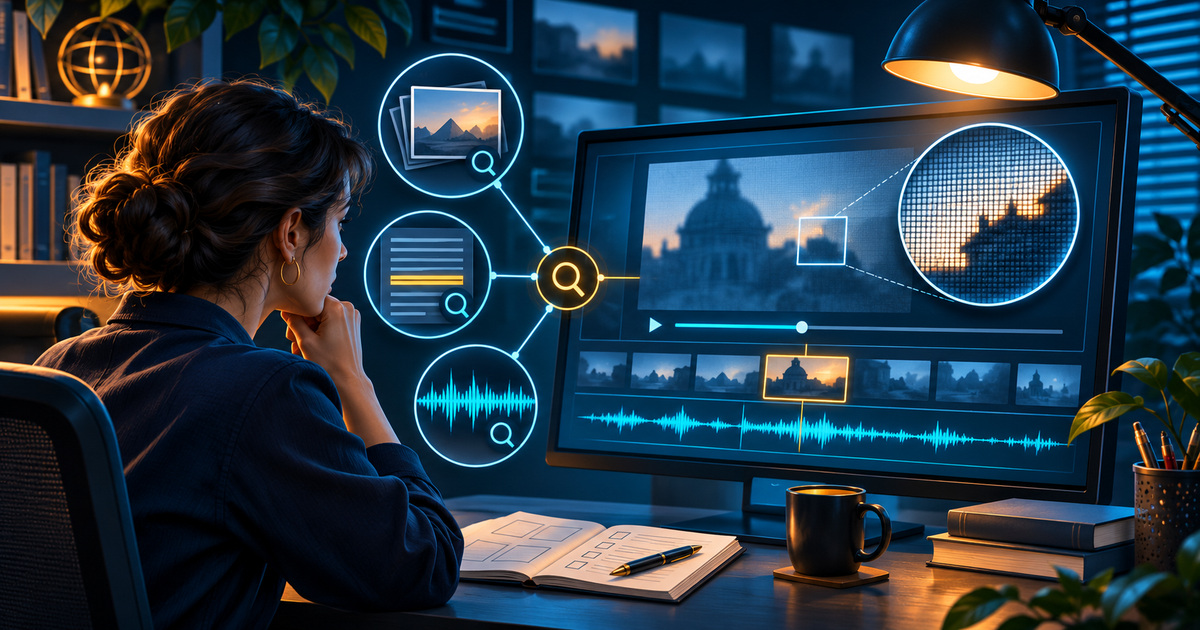
The project page describes visual inspectors for appearance, physical consistency, common sense and text, together with audio tools. Each inspection concerns a particular interval. This can focus attention on a brief local issue rather than asking one overall response to explain the entire video.
Training operates at two speeds: the investigator's policy updates faster, while the inspectors change more slowly. This is the authors' dual-timescale optimization method, not a claim that a deployed public detector independently rewrites itself. ForenCue-30K supports training the inspections and their coordination.
Why a temporal window helps
Consider an editorial example: an unusual movement appears briefly inside a longer clip. An overall description might miss it. Pointing to particular frames makes the system's claim easier to examine because a human knows where the alleged problem occurs. That is more useful than an unexplained statement that a video looks suspicious.
Localizing an observation does not establish its cause. Compression, editing, reflections or an unusual real scene can require different explanations. An inspector might find an anomaly without demonstrating that the whole recording is synthetic. A located clue is therefore a starting point for verification rather than a substitute for judgment.
The distinction becomes important when separate inspectors disagree. A text-related issue and an audio observation may concern different portions of a clip. Simply collecting more descriptions does not ensure a coherent conclusion. A reviewer needs to understand which observations actually support the decision and whether competing explanations were considered. This is our analysis of the evaluation problem, not an additional claimed property of the system.
Reading accuracy in context
An organization considering such technology should examine errors on its own material. Incorrectly flagging a real clip and missing a synthetic one have different consequences. A single average does not reveal the error type or its distribution across recording quality, languages and sources.
A useful test case would be an archive containing resized and repeatedly encoded videos. Results on original files do not fully answer what happens after those transformations. The target workflow needs to be defined and evaluated with representative examples. SIExpo has not independently validated WeVisForensics in such a workflow.
Comparisons should also preserve the same input conditions and decision rules. If one detector sees longer clips or uses a different threshold, a headline comparison may mix together several changes. Recording these conditions is a practical way to make a performance claim more interpretable without dismissing the reported research.
An explanation that can be challenged
A useful operational record would preserve the original file, inspected windows, invoked tools and final conclusion. Another reviewer could then revisit the observations and distinguish what was seen from how it was interpreted. This is an editorial documentation proposal, not a promise about a specific product output format.
A technical indicator must also remain separate from an accusation about a person. An automated result might justify further investigation; it does not establish who created a clip, their intention or the conditions under which it was made. File provenance and publication context are separate questions.
WeVisForensics is interesting because it attempts more focused and explainable inspection. The next important question is whether those localized explanations remain useful beyond selected test conditions. The work offers a research direction for better video examination, while leaving human verification and the distinction between suspicion and established fact essential.