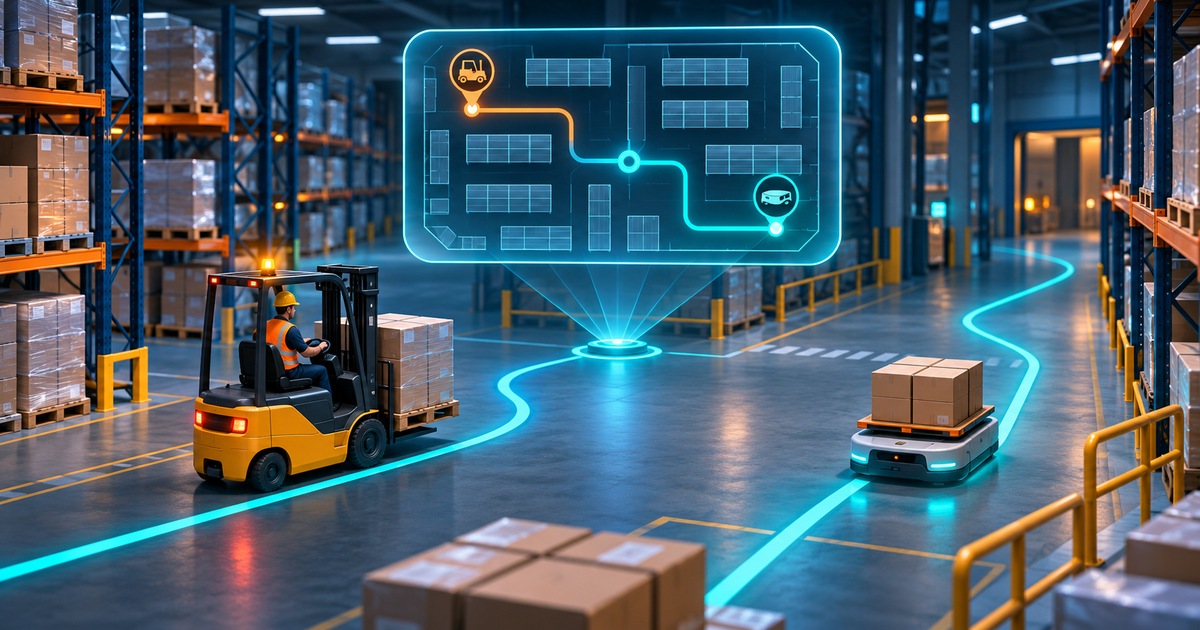
BlueBotics is bringing shared mission dispatch to manual forklifts and mobile robots through ANT locator and ANT server. Robotics & Automation News described the update on November 22. The practical idea is to allocate work to a suitable available vehicle in one system instead of maintaining separate queues for people and robots. It does not turn a manually driven forklift into an autonomous vehicle.
One queue does not mean one control method
A robot can execute an assignment through an automated controller. A manual forklift remains under its driver’s control. The described in-cab interface lets operators indicate availability and accept work. Location informs allocation, but does not eliminate human judgment or operating safety rules.
ANT locator tracks manual vehicles and their loads, while ANT server manages missions for automated machines. Connecting these functions matters during gradual automation: a business can retain different equipment types rather than replace everything at once. Public descriptions also include pallet tracking and traffic analysis; they do not establish identical performance in every warehouse.
Where the value could arise
Consider an illustrative pair of pallet requests. An available driver is nearby while a robot is carrying a load at the other end of the building. A shared system could avoid unnecessary waiting if it knows the constraints and actual availability. This is our explanation of the dispatch logic, not a measured result from a particular BlueBotics customer.
Accurate state is the harder issue. A forklift might appear available while its operator handles an exceptional job. A load might require particular forks or access to a restricted area, making the nearest vehicle unsuitable. Eligibility rules and task acceptance are therefore just as important as coordinates.
What a pilot should measure
Useful measures include empty journeys, request-to-completion time and reassignment frequency. Comparisons should use similar workloads and include operator declines and interruptions. A promise of less congestion is not a collision-prevention guarantee: dispatch software and machine safety functions are separate layers.
The confirmed development is the announced capability to coordinate mixed fleets. Independent savings figures or a universal improvement rate have not been established here. For warehouses where humans and robots share operations, the direction is meaningful precisely because it accommodates that mixed reality. The accompanying image is a conceptual AI illustration.