SCHUNK Humanoid Robotics is now operating as TACTILIA Robotics. Its November 18 announcement focuses on a modular robot hand for manufacturing and logistics. Based in Munich, the business is developing its technology independently while drawing on SCHUNK’s experience. This is an organizational and product-direction announcement, rather than evidence that general-purpose grasping has been solved.
Why the hand is a separate engineering problem
Moving a robot to a table and recognizing an object does not mean that the machine can pick it up reliably. Contact changes the situation: the object can slip, deform or arrive at an unexpected angle. For an integrator, vision, mechanics and control must therefore work together. A language model’s convincing answer cannot replace force measurement or confirmation of the final position.
TACTILIA describes a platform combining mechanics, sensing, actuation, software and physical AI. Intended applications include humanoids, collaborative robots and mobile manipulators. A common hand could make manipulation capabilities more transferable between machines, but this remains a development objective. The announcement does not establish compatibility with every robot controller or platform.
Reading the industrial promise
The company points to access to SCHUNK’s network of 15 CoLabs for customer work and practical validation. That creates a route from a demonstration to a specific application. The announcement does not provide comparable independent measurements of failure frequency, cost per successful operation or performance across all object categories. It therefore cannot establish that the new hand already outperforms an established gripper in a particular factory.
Our editorial interpretation is that value needs to be assessed at the operation level. Placing a component in a fixture, for example, requires attention to positional tolerance, dropped-object detection and recovery time. With flexible material, surface damage and the frequency of human intervention may matter more. These are different tests even when both actions are described as picking and placing.
What a buyer should ask to see
A useful pilot would use the customer’s own parts, including unfavorable starting positions, and measure a complete shift. It should show how the hand is serviced, how worn components are replaced and how the controller reports an uncertain grasp. Counting successful picks is insufficient when interruptions and manual assistance are excluded.
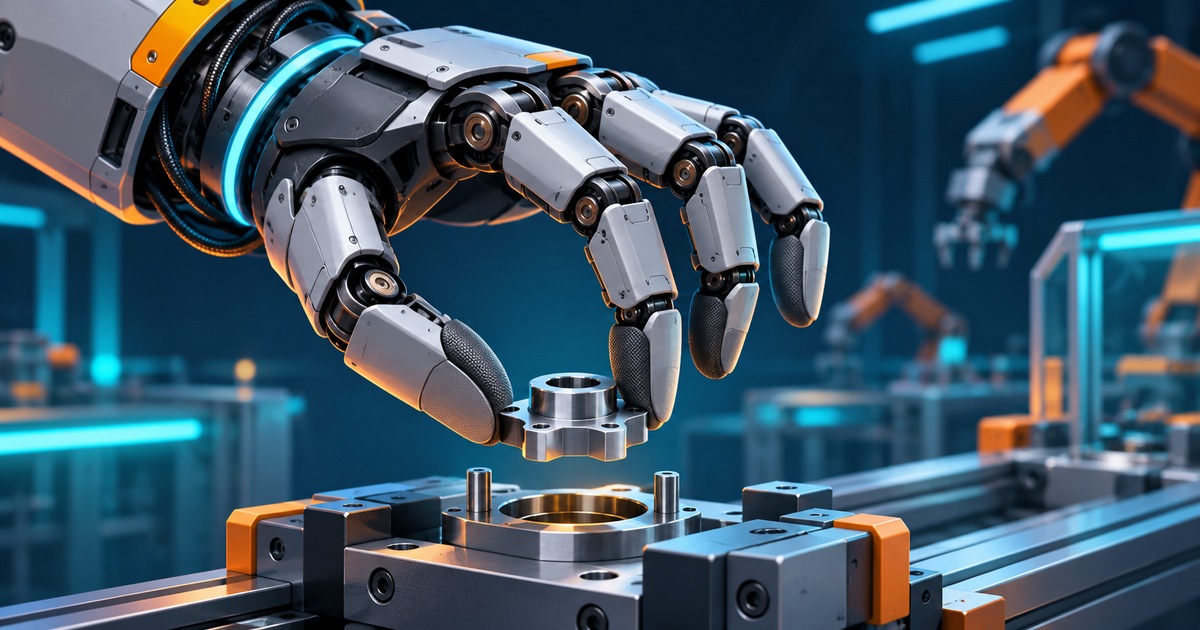
TACTILIA is notable as a European effort to make dexterity an industrial component that others can integrate. The next substantial evidence would be reproducible results in specific production tasks. For now, the confirmed development is the company’s identity and stated product direction. The accompanying AI-generated illustration is conceptual and does not depict an actual TACTILIA product.