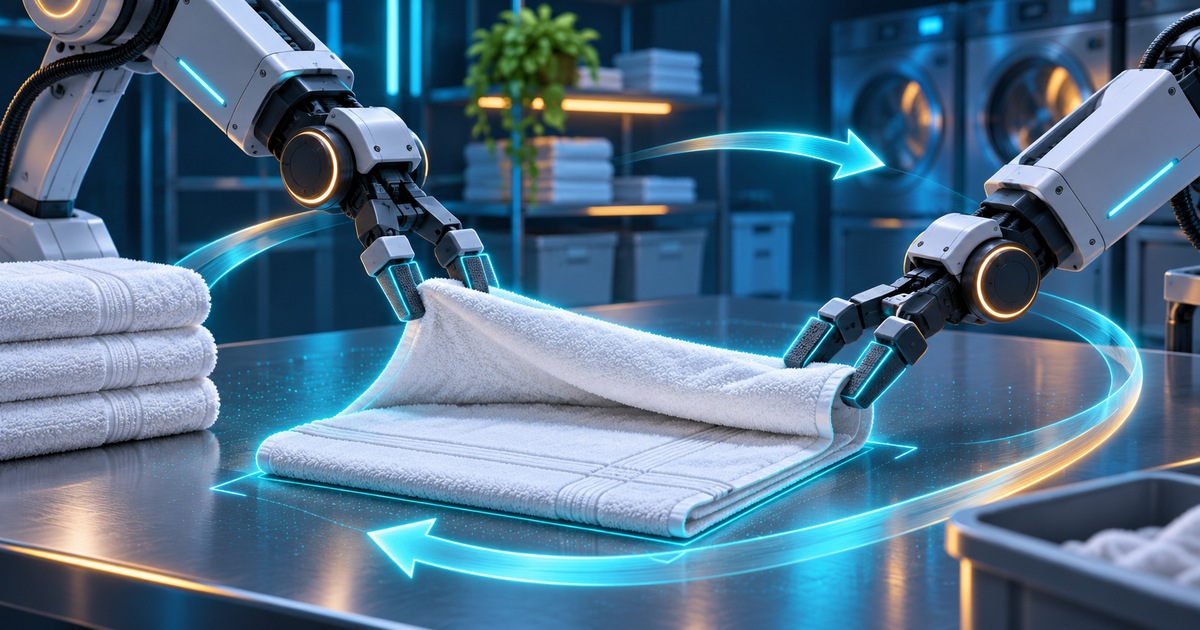
Gobano Robotics reports a robotic station folding and inspecting towels at Henri Wartner Group, an industrial laundry operator in France. A November 22 Robotics & Automation News report relays two company figures: 99.5% task success and throughput equivalent to 68% of a human worker’s over an 18-hour shift. These describe different things and do not show that the robot is faster than a worker.
Reliability and speed have different denominators
The first number describes successful execution under the company’s protocol. The second compares work completed over time. A system can complete almost every accepted operation correctly while pausing, retrying or moving slowly. An assessment also needs to establish how failed grasps were counted and when a task was considered complete.
According to the report, the station checks outcomes and can restart after a failed grasp or an unexpectedly positioned towel. Employees still replenish materials, maintain equipment and handle unresolved exceptions. This describes bounded autonomy within one process, rather than a laundry without people. SIExpo has not independently tested the installation.
Flexible objects keep changing the problem
Textiles illustrate the gap between recognition and action. Each pull changes a towel’s geometry, so an earlier observation may no longer support the next grasp. A practical system needs feedback and recovery rather than only a preplanned trajectory. This engineering interpretation helps explain why a slower system with effective recovery might still merit a production pilot.
Gobano’s public website describes physical AI for manipulating garments, parcels and other objects. It supports the broad description of the technology, but does not independently validate the figures from this particular laundry. Available public evidence is insufficient to calculate total cost per towel, a payback period or a number of jobs displaced.
Better questions for an installation
An operator assessing such a robot should request a breakdown of interruptions: which were recovered automatically, which needed a person and which created rejected output. It also matters whether measurements include replenishment, cleaning and changes between textile types. An average without those conditions can hide unacceptable bursts of work for the remaining staff.
The development is a reported application of physical AI to a specific production task. Its main lesson is that grasp success and production throughput need separate measurements. The figures remain supplier claims relayed by the specialist publication. The cover is an AI-generated illustration, not a photograph of the laundry.