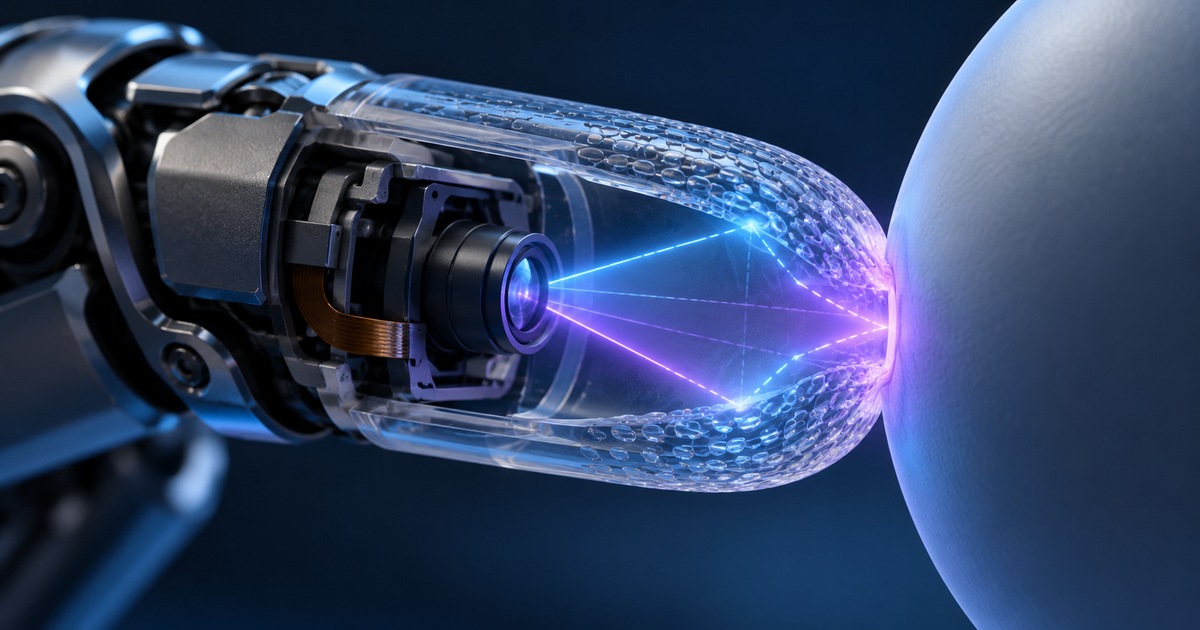
GelSlim 5.0, submitted to arXiv on October 22, 2026, combines vision and touch using one camera, a UV-responsive layer and sequential illumination switching inside a robotic fingertip.
What the study shows
The authors report an advantage for combined signals in pose and contact-geometry estimation with 12 known objects. We do not interpret this bounded evaluation as proof of dependable grasping of arbitrary unfamiliar objects.
The earlier GelSlim 4.0 work supplies context, rather than a second announcement from this week. MMint Lab’s page emphasizes reproducibility, manufacturing and modification of the sensing finger. The new study adds the question of how visual and contact observations can be organized within a shared system. The earlier project does not independently confirm the results of version 5.0.
The engineering interest
In our editorial interpretation, a shared viewpoint is interesting for tracking the transition from approach to contact. In our hypothetical example, a fingertip approaches a small plastic component and then presses it. An operator would want to compare what was visible before contact with the change afterward. Such a sequence is more informative for that particular test than a single attractive image of a deformed sensor.
We propose separating two goals in an evaluation. The first is accurate reconstruction of geometry or pose. The second is the success of an action using that estimate. If a robot measures more accurately but continues to drop the component, usefulness for the task remains unestablished. Our article does not equate these two levels of evidence or claim that a perception result automatically closes the control problem.
What to check in reproduction
For a prospective laboratory pilot, we would start with a controlled series using the same object at different angles, forces and capture times. An unfamiliar shape and material would follow. This would help distinguish measurement sensitivity from transfer to new conditions. It is our proposed verification plan, rather than an experiment already performed by SIExpo or one we attribute to the study’s authors.
Sequential capture makes time between observations an important part of that plan. If an object moves between frames, the evaluation should show whether a difference comes from illumination or from movement itself. We suggest reporting these cases separately instead of combining them with stationary contacts in a single average. The test design should make it possible to identify which condition changed.
For practical maintenance, we would also track signal changes after repeated cleaning and contact with different surfaces. This is a proposed deployment criterion, rather than a statement of proven durability. The confirmed development is a specific research architecture with a published, bounded evaluation. It makes the connection between vision and touch a clearer subject for experimentation while leaving dependable robotic manipulation an open engineering question.
*Cover: conceptual AI illustration, not a documentary photograph.*
*Editorial verification: 2026-10-24T16:31:42.890381+00:00.*