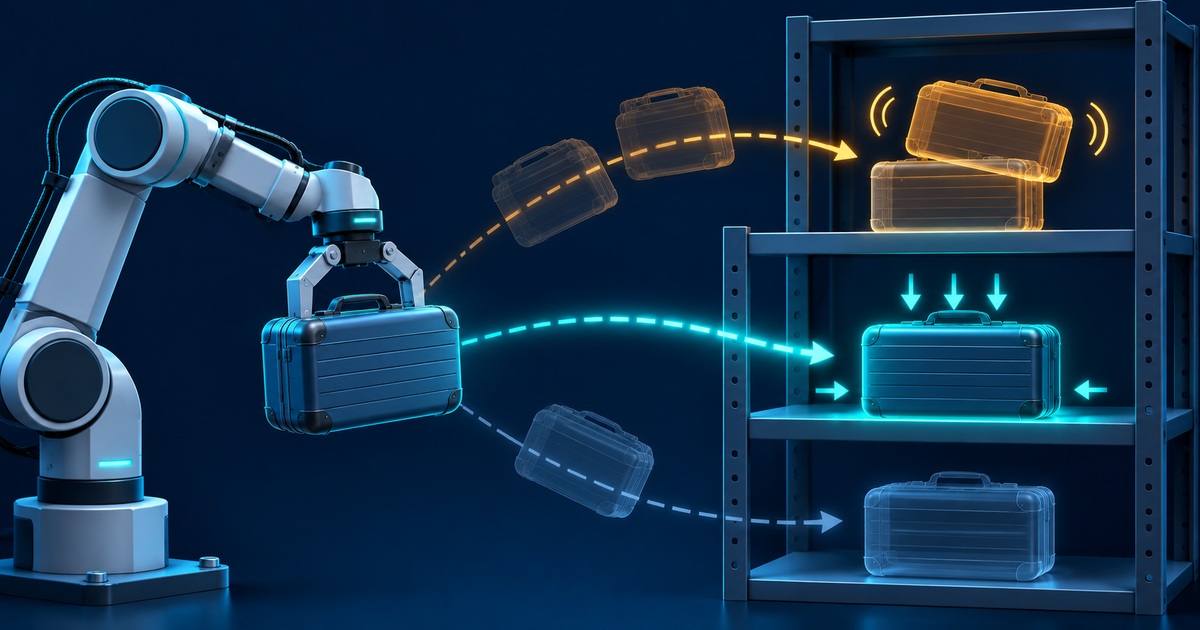
On November 11, 2026, NTT presented a world model for screening robot actions. A small shelf-loading test reports 73.1% to 92.3% success; baggage trials with Mujin remain planned.
Prediction before movement
NTT says a physics control adapter adds quantities such as mass and velocity to a video model to predict drops. This is the developer’s description; SIExpo has not reproduced the experiment.
The engineering purpose is understandable: a controller can propose a movement, while a separate prediction provides additional information before execution. That does not make every predicted scene correct. An unfamiliar object still raises questions about how its properties are estimated and what happens when the prediction itself is uncertain.
What a video test measures
NTT also uses the public OBJ3D video-prediction benchmark. Older research from SlotFormer helps explain this type of evaluation: it represents scenes through objects and assesses future frames separately from downstream reasoning and planning tasks. This is background about the evaluation setting, not independent confirmation of NTT and not a new November research release.
The distinction makes it possible to ask the right question. Agreement between predicted and observed frames is one property. Choosing an appropriate action is another. Successfully executing that action on a real robot is a third. A positive result at one level should not automatically be carried over to the others.
The original LPIPS project describes a learned measure of perceptual distance between images. Lower distance means greater similarity according to that metric. It can help assess generated frames, but it does not by itself certify safe loading, acceptable human contact or the reliability of a complete robotic system.
From a laboratory shelf to baggage
The difference between those settings matters. Consider an editorial example of a soft bag changing shape when grasped: even a realistic-looking prediction might omit an important change in support. An acceptance test therefore needs to connect the prediction with an observed outcome for the particular object and robot configuration.
A useful practical record would retain the candidate actions, selected action, prediction and actual outcome. That would help distinguish failures in perception, physical assumptions and control. This is a proposed evaluation approach, not an additional product feature asserted by NTT.
The announcement illustrates a concrete direction in physical AI: learned models helping select actions before movement, rather than merely describing a scene visually. It does not yet establish universal reliability across cargo or a finished service for airport operators. The next important evidence will be traceable results from the planned real-world trials, with objects, conditions and limitations clearly described.
Sources: NTT — physics-aware world model and robot action screening, LPIPS — original perceptual similarity implementation, SlotFormer — object-centric visual dynamics research.
The cover is a conceptual AI illustration, not a documentary photograph.
Editorial verification: 2026-11-12T07:52:16.361310+00:00.