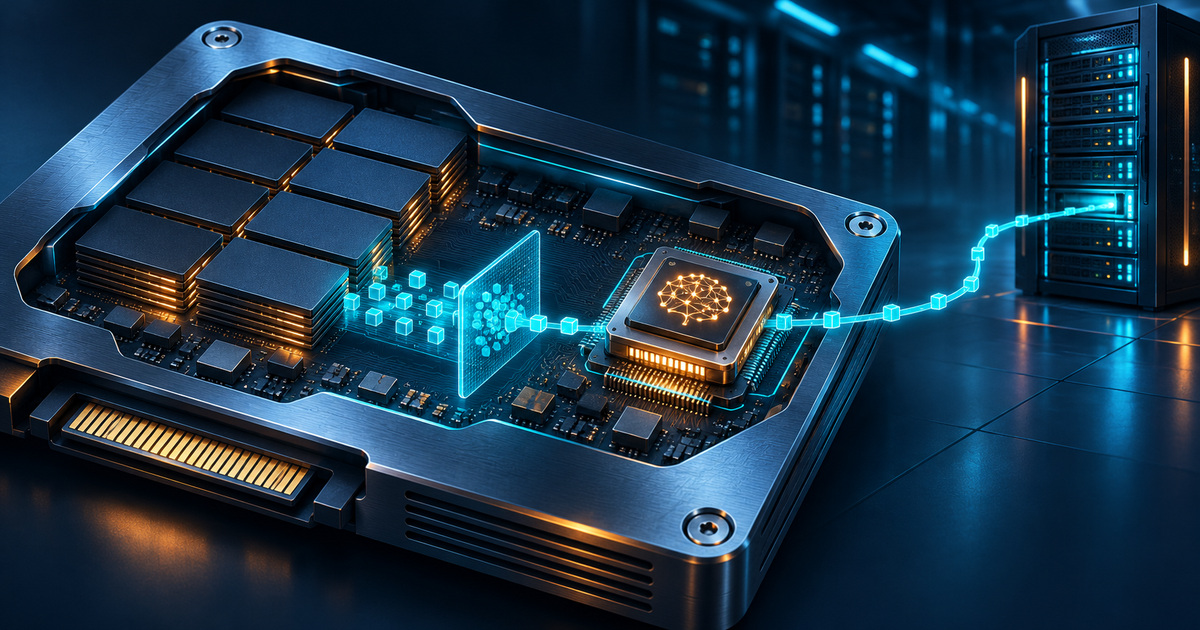
On November 17 at SC26, Phison presented a computational-storage architecture that moves processing into the SSD. The company describes an NPU and 64 GB of memory with 130 GB/s bandwidth, alongside support for PyTorch, vLLM, OpenVINO and llama.cpp. Instead of sending an entire dataset to the host, the drive would process data and return relevant results. The stated tenfold to hundredfold reduction in transfers is a vendor claim for applicable workloads.
Kaldata covered the development on November 22 and highlighted missing product details. The official announcement also says that many of the showcased features remain under development. This is therefore an architectural proposal with disclosed parameters, rather than enough information to select a finished device on price and application performance.
Where the idea could help
The following example explains the principle; it is our editorial illustration, not a published Phison benchmark. Imagine a large archive from which an application needs only records meeting particular conditions. One approach reads the archive into the host and filters it there. Another performs part of the filtering close to storage and sends a smaller result to the application.
The second approach could place less pressure on the host connection. Its value would depend on the cost of that preliminary work, how often the query changes, and how much of the archive the application ultimately needs. A workload that returns nearly everything is different from one with a highly selective filter. The presence of compute inside a drive does not determine the winner by itself.
The word result also needs definition. A set of matching records, a vector representation and a generated answer are different outputs. For an actual integration, developers need to know which operations execute inside the drive, how inputs are supplied and how failures are reported. Familiar framework names begin that conversation; they do not fully describe the execution boundary.
Different numbers describe different layers
Memory capacity, internal bandwidth and complete request latency measure different properties. A large internal transfer rate does not establish how many useful requests the complete application can serve. Likewise, moving fewer bytes does not automatically deliver an equivalent increase in generated tokens per second.
That distinction matters when comparing the architecture with a host and a separate accelerator. A fair comparison starts with the same task and dataset, then measures the whole path: reading, preparing, computing and returning the answer. Reporting only the fastest internal stage can conceal the stage at which the actual user waits.
Consider two variants of the archive example. In one, the result is small and the same data is queried repeatedly. In the other, the task requires most records and changes its processing logic frequently. These are proposed test conditions, not reported results. They demonstrate why the selectivity and reuse pattern belong next to any transfer-reduction headline.
What a convincing evaluation would disclose
A useful test would state archive size, returned-data fraction, cache conditions and concurrency. Correctness must be measured separately. A transfer reduction obtained by omitting necessary records is not the same computation performed more efficiently. Both systems must produce an equivalent answer before their speed can be compared meaningfully.
Operational evaluation should also ask how software is updated, how load is observed and what happens when a job is interrupted. These are editorial assessment criteria rather than discovered defects in a particular product. Without public measurements and an implementation interface, they remain questions for future evaluation.
Energy accounting needs the same complete-system approach. Measuring the drive and host for a finished task is different from measuring one component alone. Moving work changes where the cost appears; whether it lowers total cost is an empirical question. A diagram of the architecture cannot answer it.
Phison's proposal is interesting because it addresses data movement as a computing problem. The next meaningful evidence will identify which workloads benefit, through which software interface, and at what complete execution cost. Until then, the transfer claim should retain its stated scope instead of becoming a universal AI speedup.