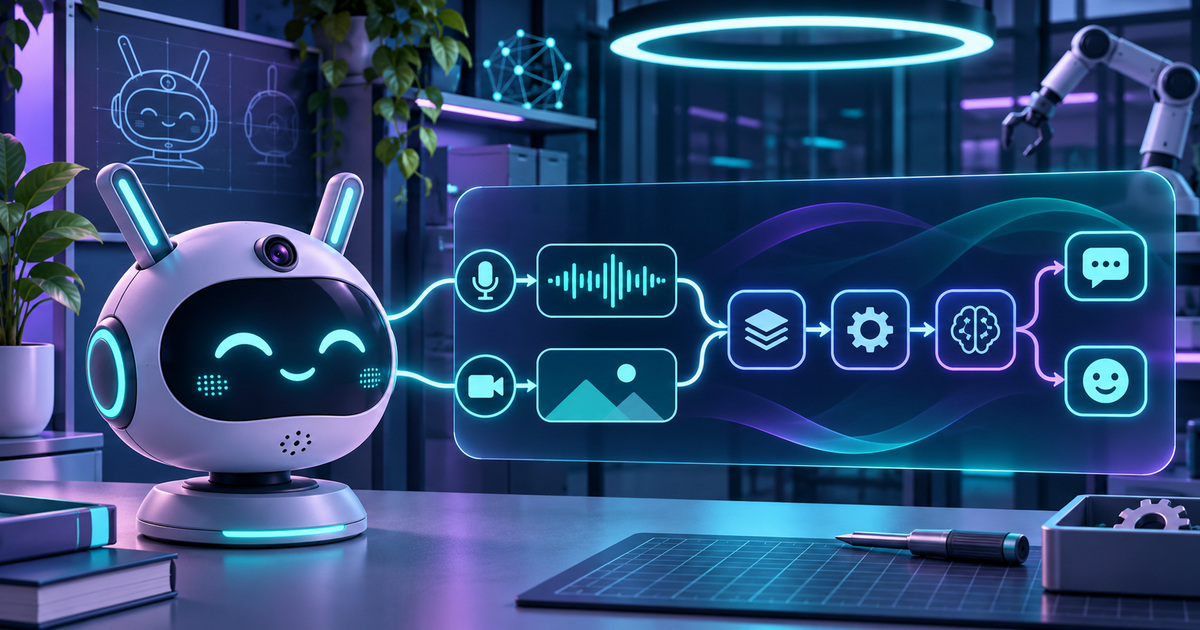
SocialMinds AI Lab presented its ROS 2 stack for Pollen Robotics' Reachy Mini on Open Robotics Discourse on November 19. The announcement identifies Lyrical, zenoh and ROS4HRI compatibility, with speech recognition and synthesis on the onboard computer. It is the team's report following laboratory use, not an independent SIExpo test.
The detailed lab page, signed in October, provides older technical background for the announcement. It describes ROS running in a container on the robot while retaining Pollen's original software. However, the stacks take turns owning the servos and camera. Having both sets of software installed does not mean that simultaneous control of the same devices is safe.
For researchers, the interest lies in a common interface between perception, speech and movement. An experiment can observe an event, choose a behavior and check whether an action finished. Having all the components does not establish that a robot understands a person's intention. That is a separate question about the task and its evaluation.
The documentation acknowledges speech-recognition errors: a loud noise can sometimes be transcribed as a short phrase. This is a useful limitation for a social robot, because a wrongly perceived phrase should not automatically trigger a consequential action. We do not infer verified Bulgarian-language support from the demonstration.
One proposed pilot is a short interaction in a separated environment: wake up, recognize an allowed phrase, make a small movement and return to rest. Silence, background noise, a disconnected network and an unavailable component should also be considered. In each state, the operator should be able to distinguish waiting, successful execution and refusal.
The announcement and technical page provide different example video profiles. We therefore do not present one frame rate or resolution as a measured property of every installation. Local acceptance work should record the version, settings and onboard workload.
The verified development is the published laboratory route to ROS 2 operation. It may support reproducible research scenarios when the configuration is described. It is not evidence of a finished household assistant, universally reliable speech or automatically safe control beyond an evaluated task.