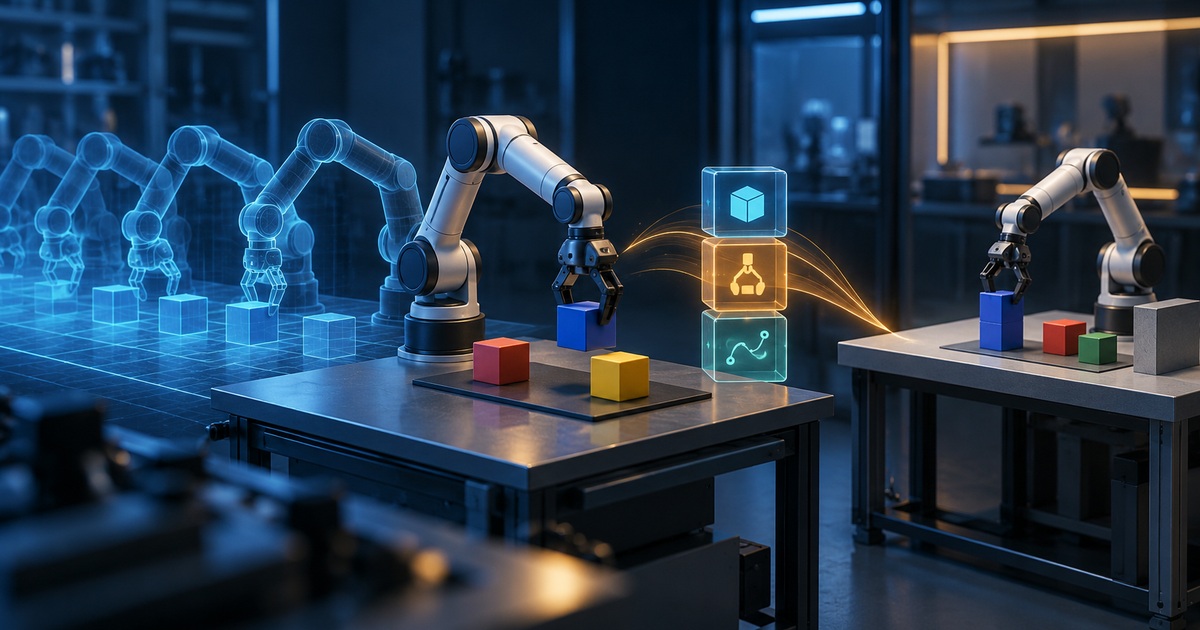
The SEAR preprint, submitted on 13 October 2026 by a Luma AI team, studies how language-model agents can improve robot control. It compares three modes: writing control code, acting in the control loop and working on model fine-tuning. Its central question is whether retained experience helps beyond the effect of additional attempts. This is research, rather than an announcement of a universal production-ready robot system.
What counts as learning
The public repository describes a generalization ladder: new starting states, new conditions, new tasks, another simulator and the real world. Its methodology also compares budgets, restarts and operation without an inherited experience library. The important distinction is what remains useful when conditions change, rather than whether an agent can find one successful execution.
Our editorial interpretation is that these controls guard against a common evaluation error. Given more time and more attempts, a system might find a working solution without acquiring a transferable skill. Separating those explanations requires accounting for available resources and the information carried forward from earlier tasks. A higher final score alone cannot identify the cause.
Consider a hypothetical robot placing an object in a box. Repeating the same convenient starting arrangement checks consistency within a narrow case. Moving the object or changing the box poses a different question. Passing the first test does not automatically answer the second. This illustrates how to read the experiment; it is not a result of an SIExpo execution of SEAR.
Memory can also carry mistakes
The researchers report that saved routines and mistaken observations can influence subsequent tasks. Their public description also distinguishes physical-robot practice from separately staged evaluation scenes. We present these as findings and limitations reported by the authors, not as experiments independently reproduced by SIExpo.
For a future practical pilot, we would want each retained skill to describe the conditions under which it was tested. A brief note saying that something works can hide dependence on a camera position, initial arrangement or tool. A useful library would preserve the boundary of the evidence alongside the procedure, so that a local success does not silently become a general rule.
From simulation to physical action
Transfer to a real system adds questions about perception and execution. In a proposed test, we would distinguish a wrongly identified object, an unsuitable action sequence and an unsuccessful movement. The overall outcome that a task failed is necessary, but insufficient to explain which part should improve. This matters when deciding whether to change the model, the tools or the surrounding process.
SEAR's value lies in asking a more demanding question about self-improvement: exactly what is retained, and under which changes does it remain useful? A public preprint and repository make the descriptions easier to inspect, but do not replace independent reproduction. The next meaningful step is sustained performance under new conditions, with comparable resource budgets and explicit success criteria.
Editorially checked: 2026-10-16T07:59:41.731577+00:00 (UTC). Cover: conceptual AI illustration, not a documentary photograph.