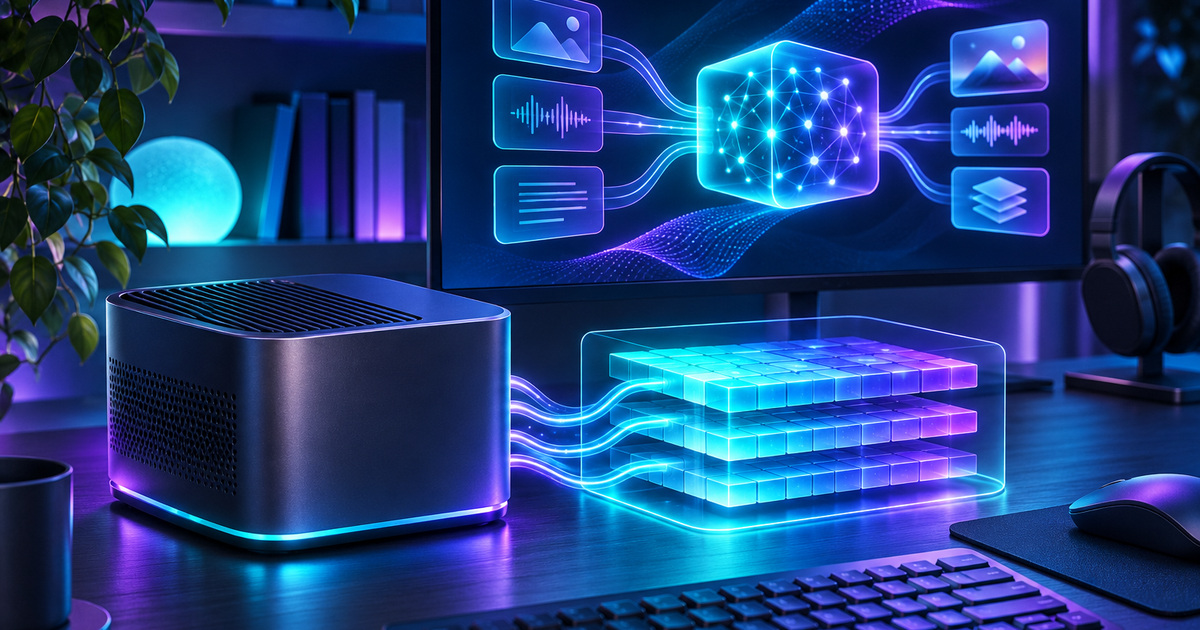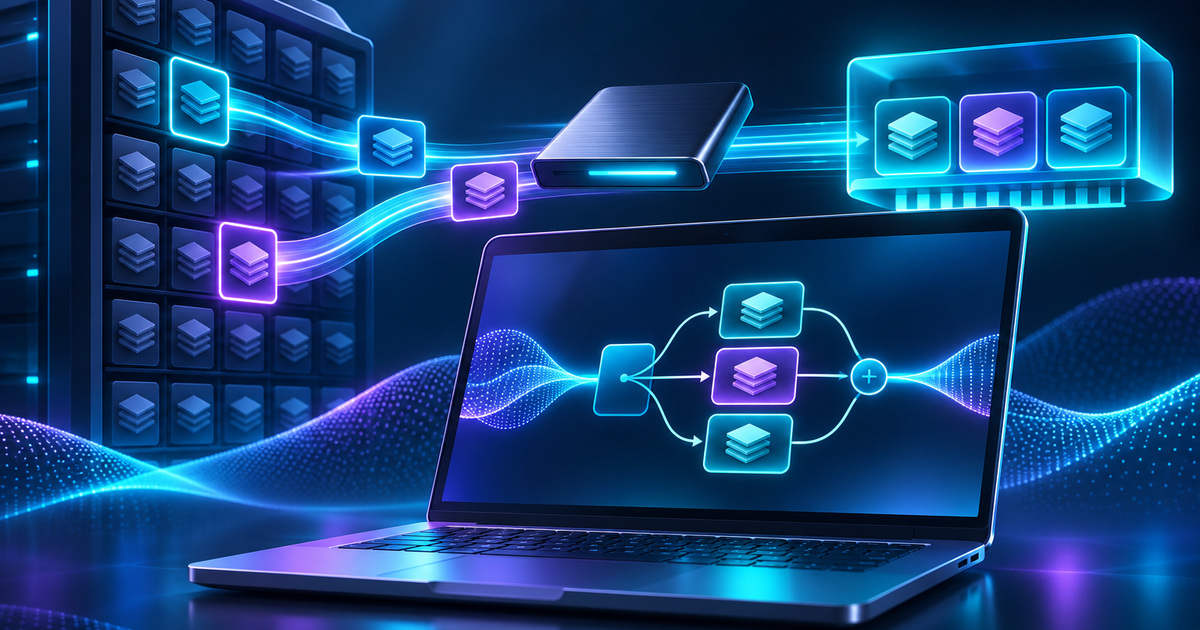
Tarek Ziadé published an experiment on November 18 that runs a large MoE model with Transformers by streaming experts from SSD. The author describes a Mac configuration with 32 GB of unified memory and Qwen3.8-Flash-Next. This is the author's prototype report with supporting code, not an independently reproduced benchmark or a promise for arbitrary laptops.
Where the weights reside
The linked pull request, #50717, is labeled a proof of concept for expert offloading. That status matters: an interface under discussion in a proposed change is different from a feature already included in a standard installation. Reproduction requires checking the exact version and the proposal's current status.
The central distinction is between storing all weights and retaining the needed portion in fast memory. In a mixture-of-experts model, routing selects a subset of experts for a computation. That permits a hierarchy of disk storage and cache, but introduces dependence on which data will be needed next. The headline parameter count has not simply disappeared.
The proposal itself warns that it is an AI-written proof of concept requiring rewriting before inclusion. That is more specific than merely calling it experimental. It is a reason to track the interface development rather than promise users a finished feature.
Capacity comes with a time cost
Our reading is that the technique needs evaluation on both loading feasibility and time to a useful result. If the active set changes continually, disk reads may become more important. If recurring components remain cached, behavior can differ. This explains the engineering trade-off; it is not a measurement of this implementation.
For a comparison, separate the first execution after startup from a later run of the same task. Record available memory, context length, exact quantization and SSD configuration as well. Without those conditions, two token-per-second figures may look comparable while measuring different operating modes.
Also include the application surrounding the model. An experimental run that consumes almost all available memory can behave differently once an editor, browser and indexing process share the machine. A useful acceptance test should represent that real working environment rather than a temporarily empty computer.
Who can use a prototype
The work is interesting for teams investigating local-inference limits and able to maintain an experimental environment. For a workflow with a firm deadline, whether a smaller model finishes on time may matter more than whether the largest model starts at all.
SIExpo has not installed this pull request or reproduced the results. The verified development is the published technical experiment and proposed integration. Moving from that experiment to a supported, predictable feature requires further tracking.