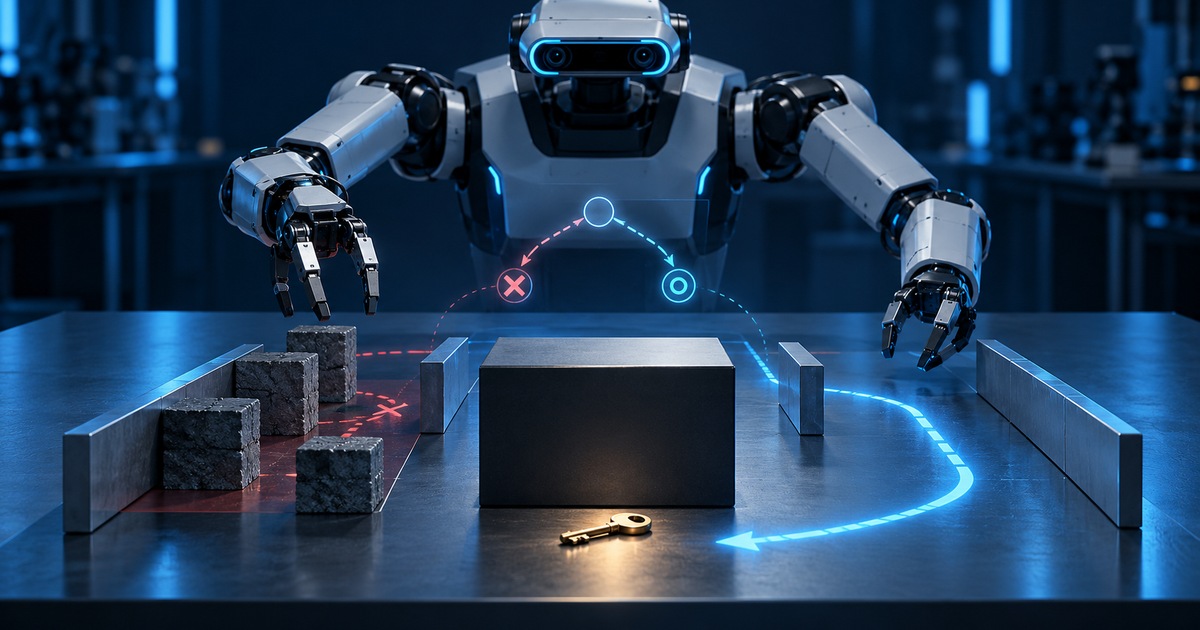
AGIBOT announced its fourth AGIBOT WORLD 2026 release on October 22, focusing on Physical Reasoning: choosing actions according to environmental state. The company connects questions and answers with trajectories, including incorrect executions.
One goal, different conditions
The presentation emphasizes decision complexity: an obstruction or occupied space changes the next action. This is a research resource, rather than independent proof of universal autonomy or industrial deployment benefits.
Our editorial interpretation is that such data is most interesting where a learned sequence appears correct only in an orderly scene. In our hypothetical example, a robot must place a box on a shelf, but its assigned location is occupied. A useful test would distinguish recognizing the obstruction, choosing an authorized alternative location and correctly deciding to request help. The final arm position alone does not explain whether the task was understood.
What the general dataset card documents
The verified AgiBotWorld2026 card on Hugging Face describes a LeRobot v2.1 organization: metadata, Parquet data and MP4 video, with separate files for episodes and cameras. The schema and paths are documented through info.json. This is documentation for the general repository; we do not attribute all its historical data and characteristics exclusively to the fourth release.
The card specifies CC BY-NC-SA 4.0. The official license description requires attribution, noncommercial use and sharing adaptations under the same conditions. Download availability therefore does not automatically grant permission for a commercial product. A team pursuing that use should clarify the applicable rights before making its workflow dependent on these data.
What would make an evaluation persuasive
We propose keeping entire families of scenes separate between training and evaluation. If nearly identical arrangements appear on both sides, a high score may leave the central question unanswered: does the decision transfer to an unfamiliar obstruction? For our example, we would reserve different box sizes, shelf arrangements and cases with no available space for testing. This is a proposed experiment, rather than a claim about an AGIBOT evaluation already performed.
A useful separate report would locate errors by stage: misread state, overlooked precondition, unsuitable plan or failed movement. This would prevent better verbal explanations from concealing a lack of improvement in physical execution. Where a human participates, the evaluation should also record how often intervention actually completes the task.
In our assessment, action selection deserves reporting separately from movement quality. Evidence of dependable performance must come from specific, reproducible evaluations, with conditions and failure cases reported alongside successful examples. SIExpo checked the published material on October 24 and has not trained or operated a robot using this dataset.
*Cover: conceptual AI illustration, not a documentary photograph.*
*Editorial verification: 2026-10-24T16:31:42.890381+00:00.*