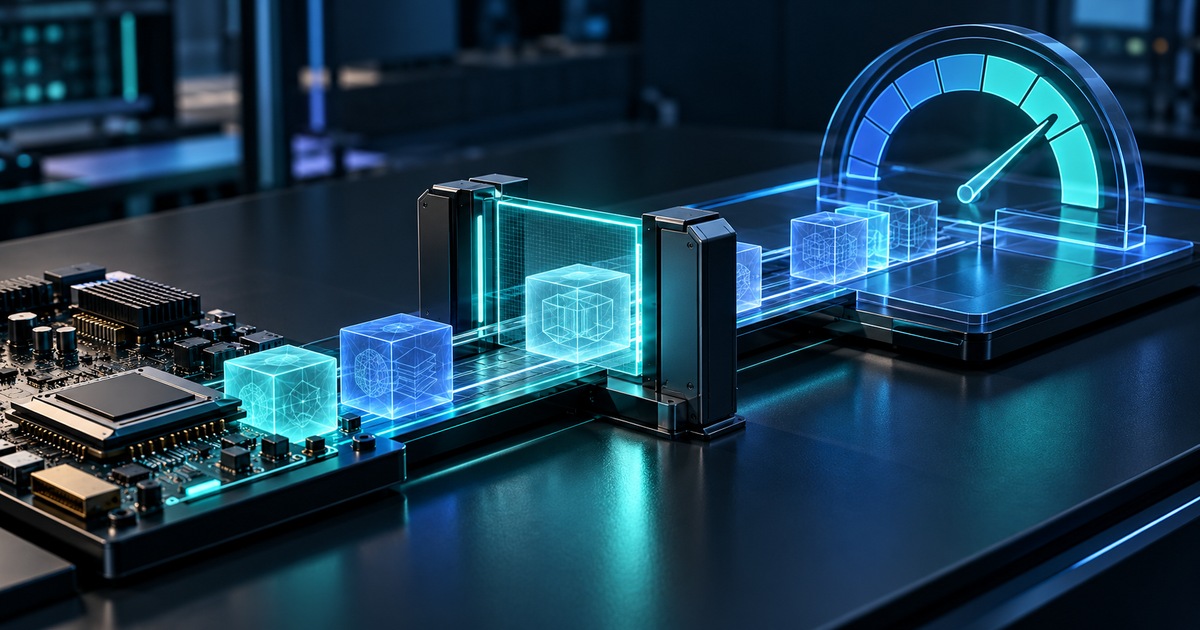
IBM advances Spyre PyTorch support with explicit stack dependencies
The new technical account connects compiler work and vLLM. Public code is not sufficient for an arbitrary installation, and measurements concern a specific configuration.

Search by Synapse
A bilingual news publication covering artificial intelligence.
Free news, analysis and guides in Bulgarian and English. Published by FalcoSoft ITS.
121–180 of 182 stories · Page 3 of 4

The new technical account connects compiler work and vLLM. Public code is not sufficient for an arbitrary installation, and measurements concern a specific configuration.

The portfolio starts with selected early-access customers. Engineering tools, oversight and the limits of reported metrics remain important.

The public transport software and OSPA address different tasks. Available code, forthcoming components and specification status are kept distinct.

The line includes tabletop and full-body robots. Deposits, hardware prices, subscriptions and optional functions need to be distinguished.

The model expands options for frequent professional tasks. Documentation separates base rates, long context and evaluation limits.

The expansion follows work in Georgia. The new operations are planned, while a cumulative tote count alone does not establish productivity or cost.

The centre collects physical experience across48 training cells. Opening the infrastructure and proving transferable skills are distinct steps.

The model has33 billion parameters and a stated long context. Public weights enable independent task and deployment evaluation.

A new technical explanation examines the choice between compiled alternatives. Output validation needs specific data, settings and a threshold.

Course preparation, training and robot evaluation have different success criteria. The new guide shows how those stages connect.

Public resources enable technical assessment. Scene consistency and practical interaction need separate measurements.

The company result concerns specific workloads. The comparison changes both model and execution engine.

The public repository is a material follow-up to API access. Self-hosting requires evaluation of resources and usage rights.

Hugging Face publishes results and scripts for bounded tests. The current dataset card requires checking versions and output-validation details.

Moonshot and Vercel describe public access to the new model. Subscription rights, context limits and future self-hosting require separate checks.

NVIDIA's current timetable points to December. We separate the planned capabilities and current specifications from the checks needed for a real local AI pilot.

NVIDIA announces an OpenUSD asset library. Profiles, versions, physical properties and licensing determine which checks a particular asset can support.

Open weights enable evaluation of a specific version. Context, quantization, resources and agent permissions need separate checks.

The company develops a vision-force-action model through simulation and reinforcement learning. Announced throughput is a scoped company result; funding does not establish production maturity.

The October19 release connects learned features to inverted indexes. Code and models support testing the quality–resource trade-off; Bulgarian needs its own evaluation.

Three DSX OS components are in developer preview. Low-water cooling designs and power approaches need assessment for each facility and workload.

Isaac Lab3.0 and public GR00T resources are distinct from future hardware and planned safety integration. Available tools do not establish a validated deployment.
IBM publishes a new model and updated speech specializations. Available weights and licensing are separate from quality on a particular language and recording.

PHP 8.2.35, 8.3.36, 8.4.27 and 8.5.12 are available. What web and AI platform operators should verify after updating.

Hugging Face describes native TPU support in Transformers and Diffusers. It simplifies software integration without guaranteeing acceleration for every model.

What is confirmed about the October 20 disruption and what Revolut showed for Bulgaria at 19:57 local time. The infrastructure incident and financial-service recovery are separate milestones.

A one-million-token context and introductory discount accompany the launch. Application value depends on time to a correct completed task as well as text-generation throughput.

The engineering account connects scale with networking, cooling and reliable training. Exact current accelerator count and total site power consumption remain undisclosed.

The 27B Gemma-based model was developed with AI Singapore. We checked the language scope, memory guidance and the difference between accessible weights and demonstrated quality.

Frontier is listed as available on Amazon.com while Eclipse is coming later. Alexa+ and shopping connections make control over shared context a central part of the product.

The October15 announcement connects retraining, a digital twin, and physical execution. Throughput and engineering-effort figures remain manufacturer claims rather than independent measurements.

IBM combines a base model with activated adapters. Its documentation sets an important boundary: the included speech recognizer supports English only.

Search and Gemini gain a shared place for products from different retailers. UCP documentation separates building a cart from sensitive payment entry and final order submission.

The 5M–209M family predicts time series rather than chat responses. Forecast ranges, correctly available covariates and testing on the intended workload matter as much as a leaderboard position.

The October 17 checkpoint is available from the official repository. Vendor scores suggest progress, while conversation encoding, tool parsing and actual execution still need separate checks.

NVIDIA announces the laptop launch. Large shared memory and Windows on Arm tools open possibilities that still need evaluation against users’ own workloads.

The two-stage design analyses conversations on-device with consent. Phased application rollout and effectiveness under real conditions remain to be verified.

816 billion parameters, text output and a specific license. Downloadable weights, hosted APIs and the two-Mac Studio configuration are distinct deployment choices.

Reflection releases Beam under Apache 2.0. Self-hosting and visible Mirror activity provide choices while preserving the need to assess actual task outcomes.

Swiss AI published its technical walkthrough on 15 October. The new document should not be confused with the first release of the already available model weights.

The joint pilot focuses on finding useful pages and recognizing changes. Discovery, ranking, citation and an actual reader visit remain different outcomes for publishers.

Super VL combines text and visual documents, while Bolt targets local tasks. We examine availability, numerical formats and the limits of vendor comparisons.

Axonex introduced a wheeled robot for educational activities. We separate company-described features and validation plans from demonstrated learning outcomes.

We checked the files, history and serving recipe. API access predates the weight upload, while the current documentation requires careful distinction between context limits.

The library is in early access. We distinguish faster computation from model accuracy and a demonstrated improvement in a semiconductor fab.

The new voice generation arrives with an automatic change to the current alias. We checked documentation and an independent index without treating a benchmark as a promise for every call.

The German company proposes a shared model for physical action. Its Berlin demonstration is still ahead; industrial reliability requires separate measurements.

The service launched on 8 October, with rules clarified on 13 October. Rapid automated findings differ from human-validated vulnerabilities.

Google announced a global rollout on 13 October. Its model card and API documentation do not establish error-free autonomous operation.

The 13 October announcement describes managed infrastructure for model adaptation. Access is phased, and cloud inference brings concrete connectivity questions.

The 13 October model offers downloadable weights and 24 billion total parameters. Compute efficiency, memory, privacy and licensing require separate checks.

The 13 October methodology focuses on work completed by agents. Signal65’s Arm-commissioned report separates measured server performance from modeled rack-scale results.

The 13 October project combines MI355X and ROCm. We examine infrastructure choices and the checks needed before practical use.

Public code and documentation show how robot commands and control priority work. The SDK is not an emergency stop or a guarantee of safe autonomy.

OCP announcements connect optical modules, cooling and rack design. Advertised capacity remains a design claim, not a result from our own testing.

The two models launch through the API and Muse Code. Documentation describes a large context window alongside limitations in spatial reasoning and long tasks.

The robotics ecosystem enters the Washington exhibition. We examine device coordination, partner integration and what it means for an operator to retain control.

The next Maia generation targets inference at scale. We explain the architecture figures and why the company’s performance comparisons need careful interpretation.
The new blueprint treats agent execution and model inference as different workloads. We examine the architectural idea and the measurements that matter before deployment.

The new model scores predefined options. What does that mean for applications, confidence measurement, and control of AI workflows?
We distinguish news from analysis and possibilities from promises. We provide context and links to original sources.
About Super Intelligence ↗